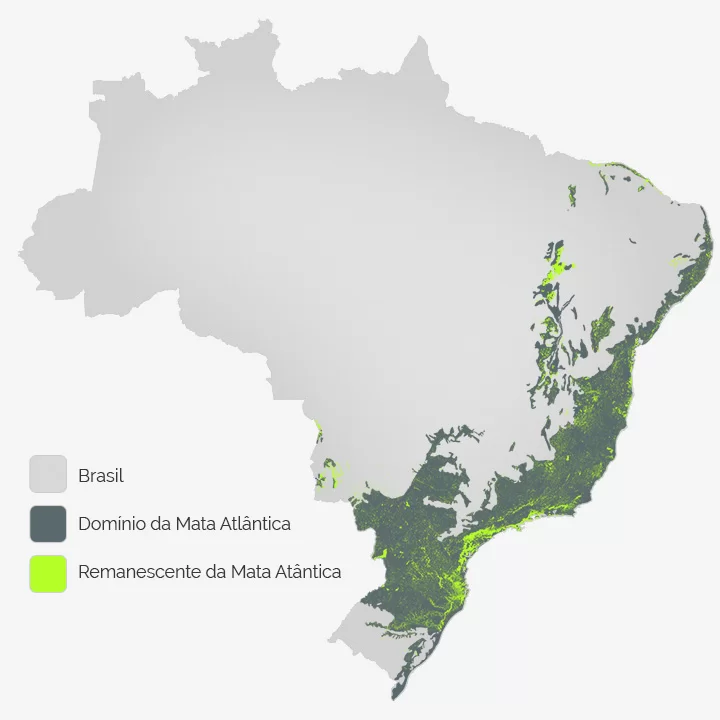
The Atlantic Forest (Mata Atlântica) is the second-largest tropical forest in South America, second only to the Amazon. Originally, its cover extended along the Brazilian coast from the state of Rio Grande do Norte to Rio Grande do Sul, reaching inland as far as Paraguay and the Argentine province of Misiones.
It was the first environment encountered by Portuguese colonizers over 500 years ago and has always enchanted the naturalists who passed through, including prominent figures such as Auguste Saint-Hilaire (1816-1822) and Charles Darwin (1832).
Today, it is home to 72% of the Brazilian population, including some of the largest cities such as São Paulo, Rio de Janeiro, Salvador, Recife, Porto Alegre, and Curitiba, and it accounts for approximately 70% of the national GDP (Gross Domestic Product).
As a result of centuries of occupation and unchecked exploitation, a large part of this forest’s territory has been destroyed or severely altered. It is estimated that only 12.4% of its original cover remains in Brazil, which once spanned approximately 1.31 million square kilometers (or 15% of the national territory).
Furthermore, most of these remnants are found in small fragments, which are insufficient for maintaining the forest’s full biological richness. The best-preserved areas of the Atlantic Forest in the country—those that are less disturbed and capable of sheltering viable populations of its characteristic species—account for only 7% of what once existed.
However, it is this small portion that still holds the primary secrets, beauty, and riches of what is one of the most important forests in the world. At this moment, every remaining piece of this biome is extremely valuable and must be protected by all Brazilians. May extensive continuous areas, such as the Great Atlantic Forest Reserve, serve as an inspiration to raise awareness among both locals and visitors of this biome.
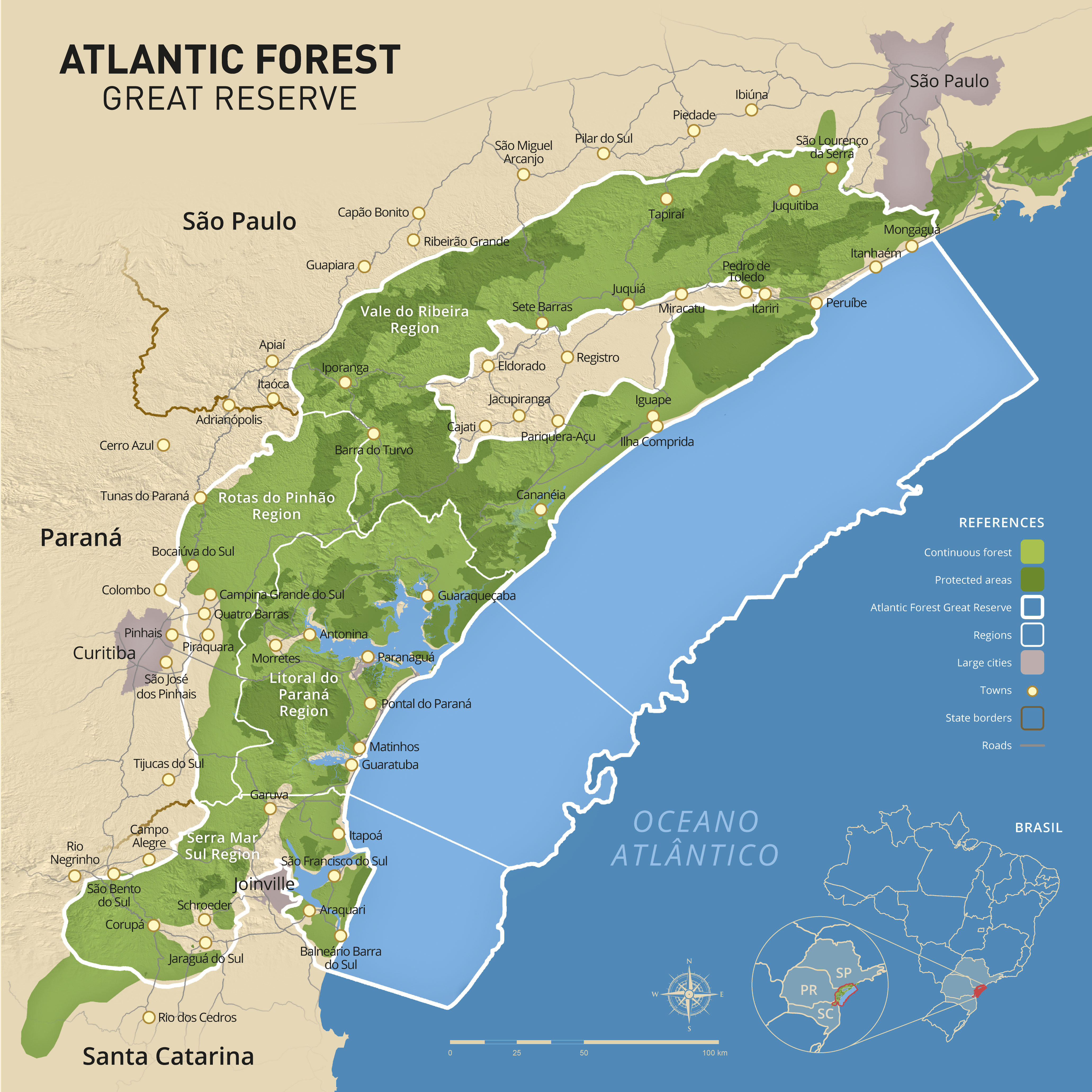
The Great Atlantic Forest Reserve (Grande Reserva Mata Atlântica) is a region of rare beauty that shelters the largest remaining continuous stretch of this biome in the world. It still maintains nearly all of its environmental diversity and species of fauna and flora, as well as its historical and cultural richness. The boundaries of this territory take into account the habitat of “top-of-the-chain” species, such as the jaguar, which require vast, uninterrupted stretches of forest to survive. Consequently, this exuberant massif is composed of 2.7 million hectares of forests and other vegetation types, along with 2.2 million hectares of marine area. Approximately 3 million people live in the 60 municipalities that share this gigantic heritage located between the states of Santa Catarina, Paraná, and São Paulo. Beyond its international relevance, it represents an excellent opportunity for Nature-Based Production in Brazil.
It is home to unique species such as the black-faced lion tamarin, the red-tailed amazon, and the southern muriqui, among many other endangered or endemic species that inhabit its diverse environments. Its privileged position, where the Serra do Mar range approaches the Atlantic coast, ensured the survival of this heritage into modern times. Furthermore, the rugged terrain allows for the existence of vital watersheds that supply everything from small communities to the large urban centers located nearby.
Within this grand nature destination, inspiring stories prevail—stories of people who dedicate their lives to protecting and valuing nature and culture. Numerous communities inhabit this territory, particularly indigenous, caiçara, and quilombola peoples. Additionally, many individuals—including entrepreneurs, educators, public officials, researchers, and conservationists—are making the Great Reserve increasingly stronger, primarily through collaborative work and the establishment of shared goals for the future of this region.
MUNICIPALITIES OF PARANÁ
– Adrianópolis
– Antonina
– Bocaiuva do Sul
– Campina Grande do Sul
– Cerro Azul
– Colombo
– Guaraqueçaba
– Guaratuba
– Matinhos
– Morretes
– Paranaguá
– Pinhais
– Piraquara
– Pontal do Paraná
– Quatro Barras
– São José dos Pinhais
– Tijucas do Sul
– Tunas do Paraná
MUNICIPALITIES OF SANTA CATARINA
– Araquari
– Balneário Barra do Sul
– Campo Alegre
– Corupá
– Garuva
– Itapoá
– Jaraguá do Sul
– Joinville
– Rio dos Cedros
– Rio Negrinho
– São Bento do Sul
– São Francisco do Sul
– Schroeder
MUNICIPALITIES OF SÃO PAULO
– Apiaí
– Barra do Turvo
– Cajati
– Cananéia
– Capão Bonito
– Eldorado
– Guapiara
– Ibiúna
– Iguape
– Ilha Comprida
– Iporanga
– Itanhaém
– Itaóca
– Itariri
– Jacupiranga
– Juquiá
– Juquitiba
– Miracatu
– Mongaguá
– Pariquera-Açu
– Pedro de Toledo
– Peruíbe
– Piedade
– Pilar do Sul
– Ribeirão Grande
– São Lourenço da Serra
– São Miguel Arcanjo
– Sete Barras
– Tapiraí
GATEWAY CITIES
Curitiba – PR | Joinville – SC | Registro – SP | São Paulo – SP