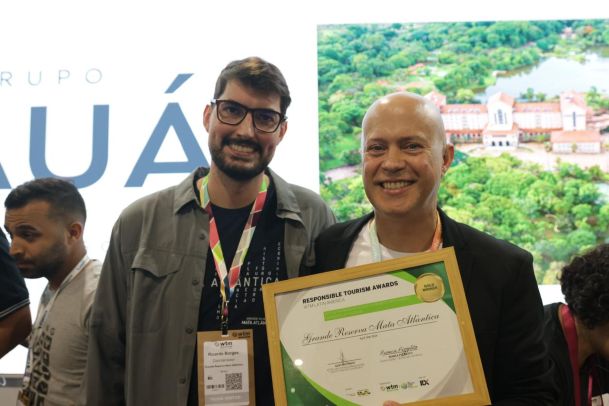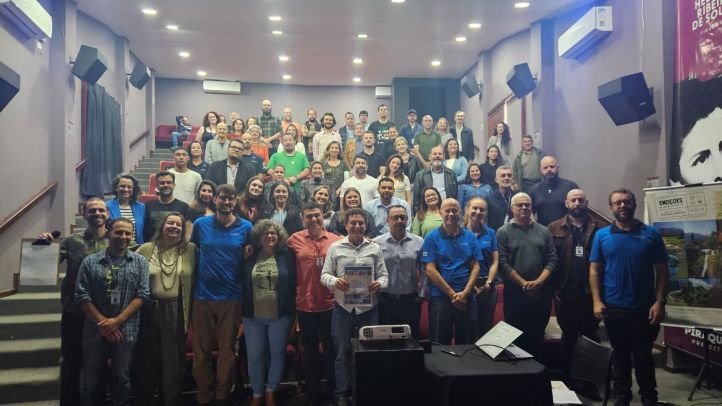
s, communications and strategic partnerships coordinator at Grande Reserva, explains how the initiative has been actively promoting efforts aimed at valuing Brazil’s natural, historical, and cultural heritage
May 27 was Atlantic Forest Day, an extremely important date to talk about the importance of conserving such a valuable biome, considered the second largest tropical forest in South America, second only to the Amazon.
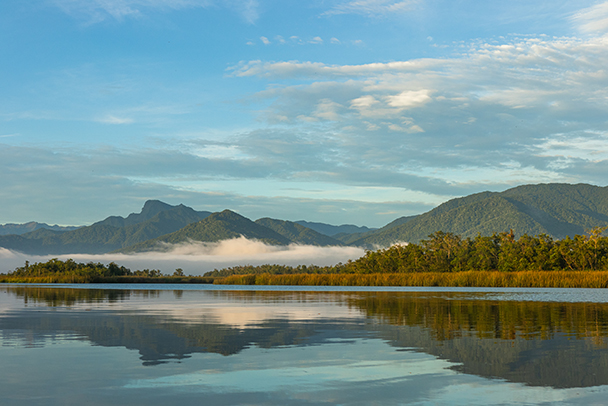 Great Atlantic Forest Reserve | Photo: Gabriel Marchi
Originally, its coverage extended along the Brazilian coast, from the state of Rio Grande do Norte to Rio Grande do Sul, reaching inland to Paraguay and the Argentine province of Misiones. It is currently home to 72% of the Brazilian population, including some of the largest cities, such as São Paulo, Rio de Janeiro, Salvador, Recife, Porto Alegre and Curitiba, and also concentrates around 70% of the country’s GDP (Gross Domestic Product).
And it was with the idea of promoting, in front of society, public authorities, and the private sector, information about the value and importance of conserving biodiversity and the Atlantic Forest for the health of life on Earth and the efficiency of any business, that the Grande Reserva Mata Atlântica initiative was created in 2018. Are you familiar with it?
In this interview, Ricardo Borges, communications and strategic partnerships coordinator at Grande Reserva, explains more about the proposal. He also shows how the initiatives to enhance the value of this enormous ecological corridor of nearly three million hectares of Atlantic Forest, connecting the states of Paraná, Santa Catarina, and São Paulo, have already been fostering real mindset changes in favor of natural heritage.
1 – May 27 is remembered as Atlantic Forest Day. Could you explain how the initiative of the Great Atlantic Forest Reserve contributes to the conservation and protection of this biome since it was conceived in 2018?
Brazil is a country of continental proportions. Few countries have the privilege of containing, within their territories, six distinct biomes, in addition to marine ecosystems. In this context, the Atlantic Forest stands as the second largest tropical forest in South America, second only to the Amazon. Originally, its coverage extended along the Brazilian coast, from the state of Rio Grande do Norte to Rio Grande do Sul, reaching inland to Paraguay and the Argentine province of Misiones. It is currently home to 72% of the Brazilian population, including some of the largest cities, such as São Paulo, Rio de Janeiro, Salvador, Recife, Porto Alegre and Curitiba, and also concentrates around 70% of the country’s GDP (Gross Domestic Product).
As a result of centuries of occupation and rampant exploitation, this biome has had much of its territory destroyed or severely altered. It is estimated that only 12.4% of its original coverage remains in Brazil, which was approximately 1.31 million square kilometers (or 15% of the national territory). Additionally, much of these remnants are found in small fragments, insufficient to maintain all of its biological richness. The best-preserved areas of the Atlantic Forest in the country, that is, less disturbed and capable of supporting viable populations of its characteristic species, correspond to only 7% of what previously existed.
However, it is this tiny portion that still holds the main secrets, beauties, and riches of what is one of the most important forests in the world. At the present time, all the remaining pieces of this biome are extremely valuable and should be recognized and protected by all Brazilians. It is for this reason that commemorative dates such as Atlantic Forest Day help bring people closer to the importance of conserving this biome, on which a large part of our population depends. It is worth remembering that these natural areas provide the essential ecosystem services for all our economic activities and ensure the quality of life for many Brazilians.
The Great Atlantic Forest Reserve was born from the conviction that the preservation and conservation of nature are fundamental for the planet’s balance and for future generations. It advocates that tourism can be a positive economic activity when conducted responsibly and sustainably, with the potential to promote a restorative economy and improve the quality of life for dozens of traditional and historical communities. This work offers a unique opportunity for the conservation of one of the world’s most important biodiversity areas.
The initiative began in 2018 and aims at the development of a region with nearly 3 million hectares of unfragmented natural areas, covering parts of the states of Santa Catarina, Paraná, and São Paulo. The Great Reserve connects existing Conservation Units and helps promote initiatives focused on the appreciation of natural, historical, and cultural heritage.
It is a region of rare beauty that hosts the largest remaining continuous stretch of this biome in the world. It still retains almost all its diversity of environments and species of fauna and flora, as well as vast cultural and historical richness. In this major nature tourism destination, inspiring stories prevail of people who dedicate their lives to protecting and valuing nature and culture. There are various communities present in the territory, especially indigenous people, caiçaras, and quilombolas. In addition, entrepreneurs, educators, public servants, researchers, conservationists, and many others strengthen the Great Reserve every day, mainly through collaborative work and shared goals for the region’s future.
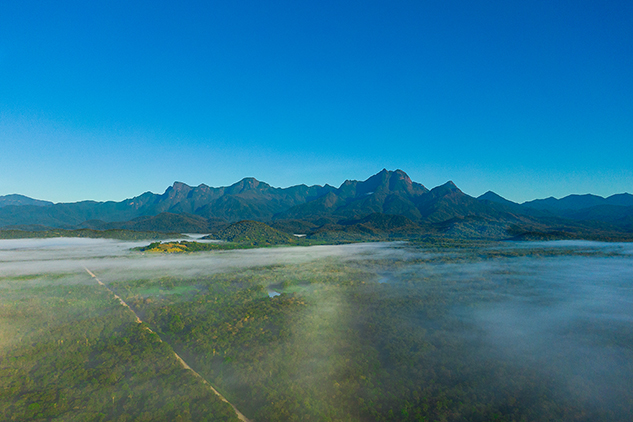 Great Atlantic Forest Reserve | Photo: Gabriel Marchi
2 – How many hectares of the Atlantic Forest does the Grande Reserva initiative aim to conserve? And can you explain how this conservation incentive occurs through the work?
The delimitation of this territory takes into account the habitat of ‘top-of-the-chain’ species such as the jaguar, which require large, uninterrupted stretches of forest to survive. In this way, this lush massif is made up of 2.7 million hectares of forests and other types of vegetation and also includes 2.2 million hectares of marine area. About 3 million people live in the 60 municipalities that share this massive heritage.
We believe that the vocation of territories such as the Grande Reserva Mata Atlântica is the Production of Nature, that is, a development model focused on a restorative economy, where the good conservation of ecosystems and the strengthening of local culture and history are drivers of job and income generation. Structuring a tourist destination based on the Production of Nature is a major challenge that involves various actors in the territory, and the adoption of the Collective Impact methodology and its strategic approach to intersectoral collaboration is timely for complex scenarios where individual initiatives are important but insufficient to solve the problem at hand.
The initiative operates in a way that encourages and catalyzes the organization of groups that meet the cultural, structural, environmental, and social characteristics of each location. To facilitate discussions, the space has been subdivided into Sectors and Portals, micro-regions corresponding to distinct regional boundaries, identified by their tourism vocation/potential, through which visitors can access natural, cultural, and historical attractions. The delimitation and naming of the Access Portals in each Sector is carried out through a collaborative process during meetings with local representatives. In this way, the Greater Atlantic Forest Reserve promotes a network of partnerships that extends from communities to broader regional initiatives.
The establishment of the Great Atlantic Forest Reserve Portal Network represents the creation of a collaborative platform that facilitates and encourages joint actions involving representatives from a wide range of areas and different regions, who until then had not envisioned possibilities for joining forces.
This group includes public institutions, private companies, civil society organizations, and individuals who work to disseminate and promote sustainable development, always voluntarily. The work of all members is horizontal, without hierarchical levels, where everyone is treated equally. These are organizations and individuals who collaborate in a joint process based on a common vision: “The Great Atlantic Forest Reserve recognized nationally and internationally as a tourist destination guided by nature conservation and the appreciation of cultural and historical heritage, a tourist destination as important as the Pantanal and the Amazon.”
The Network has no leaders or spokespersons. Decisions, when necessary, are made in collective meetings where consensus is always sought. Everyone is a potential spokesperson for the initiative, and the group also encourages leadership actions from its members. Regular meetings are the main forum for coordination and deliberation, as are the various Working Groups, created at member request to advance specific issues.
One of the key elements of the entire process was the establishment of a Charter of Principles, which outlines the core ideals that unite these members in pursuit of sustainable development for the region. Therefore, organizations and individuals who are invited or request membership on their own initiative must agree to the following:
- To share the same objectives as the Network of Portals regarding the dissemination and promotion of the conservation of natural and cultural heritage and sustainable tourism development;
- Subscribe to the Charter of Principles, committing to follow it;
- To have the agreement of all organizations and individuals that are part of the Network of Portals.
All members of the Portal Network represent good examples to be followed in their own communities and should be valued and recognized for their work. At the same time, they are responsible for establishing and, whenever possible, improving the quality of the services and products offered.
The Charter of Principles is not intended to segregate or exclude individuals or institutions interested in collaborating with the Great Atlantic Forest Reserve. It is a guiding document, indicating a possible path for all members to act, individually or collectively, in the same direction.
3 – How many Conservation Units exist in the territory of the Grande Reserva? And what are their categories?
Conservation Units are key components within the concept of Nature Production. They form the basis of a restorative economy, ensuring the existence of natural areas in their many categories, adapted to the characteristics and particularities of the location where they are situated.
Around the world, countries with distinct characteristics and resources have their own tools for the protection of natural heritage; however, the creation of protected areas is one of the main strategies adopted for this purpose. In Brazil, the National System of Conservation Units (SNUC), established in 2000 by Law No. 9,985, is the entity that sets criteria and standards for the creation, implementation, and management of Conservation Units.
There are twelve main categories with different objectives and characteristics, most of which already exist within the territory of the Greater Atlantic Forest Reserve. Conservation Units can be created at various levels: at the national level, where the responsible body is the Chico Mendes Institute for Biodiversity Conservation (ICMBio); at the state level, which are the responsibility of environmental agencies, in this case, the Institute of the Environment (IMA-SC), the Water and Land Institute (IAT-PR), and the Forest Foundation (FF-SP); at the municipal level, this responsibility lies with the Environmental Secretariat of the respective municipality.
These categories are divided into two groups:
- Integral Protection Units: their main objective is the protection and conservation of nature, allowing only indirect use of natural resources. In these areas, there can be no human occupation and, in the case of Biological Reserves and Ecological Stations, visitation is not allowed;
- Sustainable Use Units: reconcile the use and management of part of their natural resources with the conservation of nature. Many traditional populations live in these areas, except for the Private Natural Heritage Reserve (RPPN), which is classified as for sustainable use but is privately owned.
In the Great Atlantic Forest Reserve, the first Conservation Unit created was the Alto Ribeira Tourist State Park (PETAR) in 1958, followed by the Cardoso Island State Park four years later. In the Paraná portion, the first unit was the Lauraceae State Park in 1979, where the first federal unit was also created, the Guaraqueçaba Ecological Station, in 1982. At this time, a large part of the Atlantic Forest had already been devastated throughout Brazil after decades of extractive exploitation. Remnants like this have become increasingly rare throughout the country, and their importance for the conservation of nature motivated the creation of an extensive mosaic of protected areas of various categories across this territory in the following decades, especially from the 2000s with the establishment of the National System of Conservation Units (SNUC). Today, there are more than 110 Conservation Units within the territory of the Great Atlantic Forest Reserve, representing one of the largest concentrations of protected areas in the entire national territory.
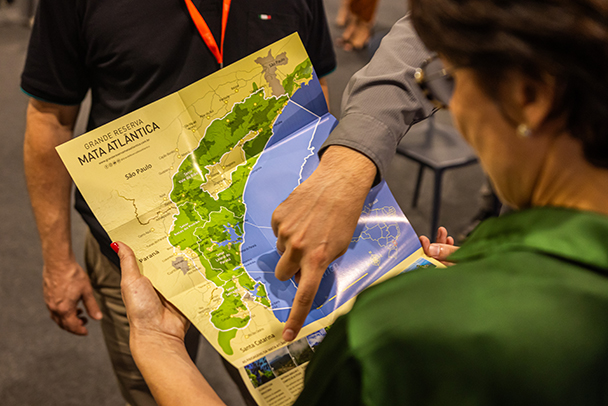 Great Atlantic Forest Reserve Folder | Photo: Gabriel Marchi
4 – In what ways has the public authority been supporting the initiative over the years? And how does this benefit the biome?
The participation of public authorities at all levels is essential for the success of initiatives such as the Great Atlantic Forest Reserve. Starting with the municipal context, which has the most direct impact on actions in the territory, we created a Municipal Commitment Charter in 2021. It is a document for voluntary signing by municipal management and includes commitments to good management practices to strengthen the entire territory. Among the points raised are:
- Creation and/or strengthening of the Environment and Tourism secretariats;
- Creation and/or strengthening of municipal councils for the Environment and Tourism;
- Structure natural attractions and adopt GRMA’s visual identity in the signage of these locations;
- Implement a tourist information point with information on services and natural resources;
- Raising funds for the restoration and preservation of municipal historical heritage;
- Join tourism governance bodies;
- Promote training for businesspeople and entrepreneurs;
- Encourage businesses with social impact and nature conservation;
- Collaborate directly with the implementation of Portals in the GRMA initiative Sectors as a way to strengthen local businesses;
- Implementation of the Municipal Atlantic Forest Plan – PMMA.
Today we have already reached 36 signatures out of the 60 municipalities in the territory, which we consider an excellent result, as it shows that most municipalities understand that sustainable development based on a restorative economy is a viable path for generating benefits for their population, especially to promote jobs and income for young people, who often have to leave their region in search of better opportunities in large urban centers.
At the state and federal level, the initiative has also sought, over the past few years, to obtain synergies with development objectives and plans for this territory, especially presenting Nature Production as a viable model and the Grande Reserva Mata Atlântica initiative itself as a replicable methodology in other regions.
5 – How many people currently participate as supporters in the Grande Reserva initiative, and what role do they have in the group?
Today, the Great Atlantic Forest Reserve Portal Network has more than 800 members spread across all 60 municipalities of the territory, as well as people from other regions who are interested in the work being carried out and participate as supporting partners.
This collective is quite diverse, as it is open, voluntary, and free of charge, and includes representatives from public institutions, private companies, civil society organizations, and individuals. We seek to promote tourism initiatives and experiences connected with nature and local culture through a network of horizontal management without hierarchical levels. The only prerequisites are signing the Charter of Principles and having an interest in participating in a collaborative process. Our areas of activity include establishing a common agenda, joint action plans, and information exchange among members. We coordinate, develop, and strengthen actions aimed at the conservation and enhancement of the natural, cultural, and historical heritage of the territory.
Every month, members are individually invited to follow-up meetings on the work, which aim to track pending issues, share information, discuss emerging matters, and ensure transparency of all actions carried out. All meetings have a previously agreed agenda and are recorded in minutes on the initiative’s website.
In addition, we also have dozens of thematic working groups, either organized by Portals (different regions that make up the territory), or by topics of interest, such as cycle tourism and trails, marketing, birdwatching, solid waste management, among others. The pace of the work is the result of the members’ participation and dedication.
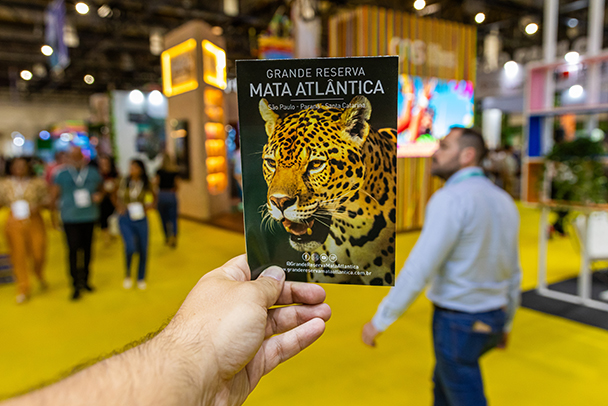 Great Atlantic Forest Reserve Folder | Photo: Gabriel Marchi
6 – Finally, comment on how the protection of natural heritage, in general, can help prevent climate catastrophes like the one we are seeing in Rio Grande do Sul.
At a global level, we are experiencing a unique moment in human history. Our impact on the planet’s ecosystems has made mass species extinction and climate change a reality that already affects the daily lives of most people. For the first time, we are facing a shortage of nature. It is worth noting that until very recently, just a few generations ago, we held the false idea that the planet’s natural resources were infinite and could be exploited in this way. Unfortunately, the bill is coming due, and much faster than we imagined, yet there are still people and sectors of the economy that ignore these effects and continue to consume our natural resources recklessly. Initiatives like the Great Atlantic Forest Reserve seek to put an end once and for all to this false dichotomy between nature conservation and development. Now more than ever, we need to think about producing nature today, whether by protecting the few areas that are still well preserved or through restoration of Degraded areas. In addition, we need to encourage more modern and qualified development models that use well-preserved natural areas as engines for generating jobs and income, as well as ensuring people’s quality of life.
The Atlantic Forest is a source of water for the majority of the Brazilian population, and the sustainability of these reservoirs is directly linked to the level of conservation in which they are found. With the worsening of climate change, these natural areas also provide protection against extreme events, such as heavy rainfall or prolonged droughts. Biological diversity is, at the same time, a defense against pests and a rich source of new technologies, stemming from biomimicry (for engineering and design), the discovery of new pharmaceuticals, and even the commercial exploitation of fruit species, honey, and PANCs (Non-Conventional Food Plants).
Furthermore, we cannot forget the importance of these areas for human health. The relationship with natural environments is much deeper than one might think, and the growing number of people in large urban centers has been demonstrating this. Contact with nature can aid in patient recovery, prevent or assist in the treatment of psychological problems, and significantly increase immunity, among many other examples linking natural environments to physical and mental health. Having parks available, easily accessible, and well-structured, close to the population, is an investment in people’s quality of life and in the full development of a society.
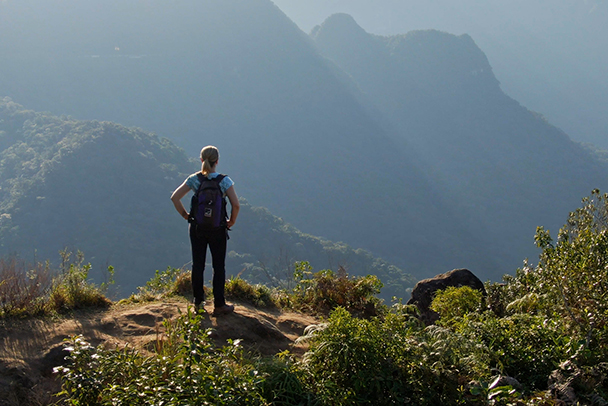 Great Atlantic Forest Reserve | Photo: Gabriel Marchi